
Factory-Direct Heavy-Duty IBC Components & Valves
Explore our top industrial-grade IBC closures, replacement gaskets, ball valves, and heavy-duty structural bases engineered for rigorous liquid logistics.
Global Commercial Landscape of Industrial IBC Containers & Fittings
An empirical evaluation of global intermediate bulk container trade flows, material innovations, and supplier ecosystem dynamics.
The 2026-2032 Industrial Bulk Packaging Dynamic
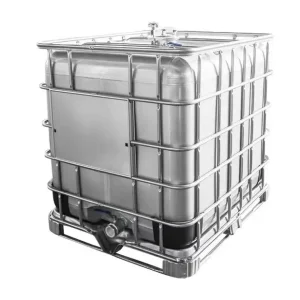
Intermediate Bulk Containers (IBC totes) have become the cornerstone of modern global liquid logistics. Valued at over USD 10.8 Billion globally, the demand for high-integrity 1000-liter composite IBCs, 304/316 stainless steel totes, and high-density polyethylene (HDPE) vessels continues to expand at a CAGR of 6.2%. The driving force behind this expansion is the global cross-border movement of hazardous chemicals, agrochemical formulations, liquid food ingredients, and specialty lubricants.
Within this complex supply chain, the operational stability of an IBC unit does not rest solely on its outer blow-molded bottle or tubular steel cage; rather, it hinges directly upon the micro-engineering of its valves, screw lids, PTFE sealing washers, and discharge adapters. A single micro-crack or chemical permeation failure in a bottom outlet valve can result in catastrophic environmental contamination, regulatory penalties under UN dangerous goods transportation standards, and substantial financial losses.
Why China Dominates Global IBC Component Manufacturing
China has established itself as the world’s primary manufacturing epicentre for industrial IBC fittings, precision valves, and tote structural accessories. Concentrated in industrial clusters across Shandong, Jiangsu, and Zhejiang, Chinese OEM/ODM factories combine raw material integration (high-grade resin synthesis, precision steel extrusion) with advanced high-tonnage injection molding technology.
A leading China IBC fittings supplier & factory provides global tote reconditioners, chemical bottlers, and packaging distributors with unmatched economic scaling, rapid tooling development, and structural compliance certified under ISO 9001, CE, and UN 31HA1/Y packaging specifications.
Information Gain Key Insight: Modern procurement strategy has shifted from sourcing complete IBC containers locally to importing modular, high-spec replacement fittings (DN50/DN80 integrated valves, fluorinated breathers, and heavy-duty metal bases) directly from specialized China factories, reducing total asset ownership cost by up to 38%.
Technical Trends & Material Innovations in IBC Manufacturing
High-performance polymer science, advanced elastomer sealing chemistry, and structural mechanical upgrades.
Fluorinated & PTFE Sealing Chemistry
Standard EPDM and Nitrile gaskets often degrade or swell when exposed to aggressive organic solvents, concentrated acids, or aromatic hydrocarbons. Leading China IBC fitting suppliers now incorporate PTFE (Polytetrafluoroethylene) encapsulated rubber washers and pure FKM/Viton seals. Fluorination treatments on HDPE screw caps create a chemical barrier that prevents solvent vapor migration and sidewall container collapse during ocean transit.
Anti-Static & EX-Zone Compliance
For dangerous goods operating in ATEX Zone 1 and Zone 2 environments, electrostatic discharge poses an explosive risk during rapid filling or discharge. Advanced China factories are compounding high-density polymers with carbon nanotube additives and conductive stainless steel grounding wires. This ensures surface resistivity remains strictly below 10^6 Ohms, satisfying international UN Ex-safety protocols.
Smart Vented Closures & Pressure Relief
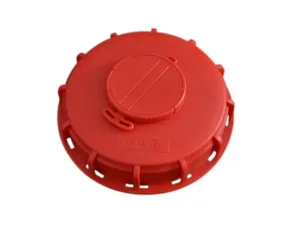
Temperature fluctuations during long-distance shipping cause volatile liquids to off-gas, leading to internal pressure build-up or destructive vacuum creation. Modern red breathable IBC lids utilize hydrophobic ePTFE (expanded PTFE) microporous membranes. These membranes allow gas molecules to equalize while maintaining an absolute liquid-tight seal up to 0.2 bar hydrostatic pressure.
IBC Fitting Material Compatibility & Specification Matrix
Technical comparison table for engineering managers and B2B procurement specialists assessing fitting material viability.
| Component Type | Material Options | Thread / Standard Sizes | Chemical Resistance | Primary Industrial Application |
|---|---|---|---|---|
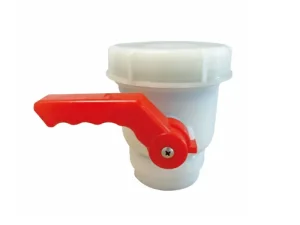
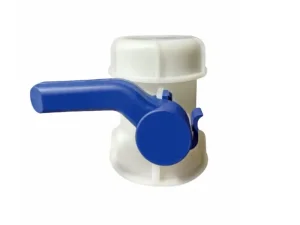
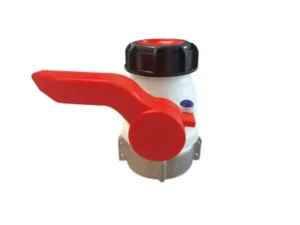
| Bottom Discharge Valves | HDPE, PP, SS304, SS316L | DN50 (2"), DN80 (3"), S60x6, S100x8 | Organic acids, alkalis, food products, solvents | Bulk liquid chemical transfer, agricultural pesticides |
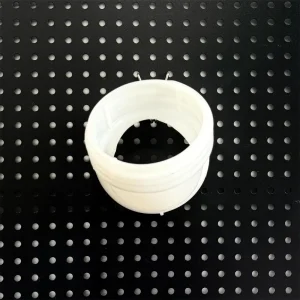
| Sealing Gaskets & Washers | PTFE, Viton (FKM), EPDM, NBR | Custom, DN50/DN80 screw fitting sizes | Broadest solvent spectrum (PTFE), high temp (FKM) | Hazardous liquid transport, oil & fuel packaging |
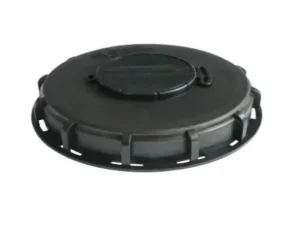
| Top Screw Lids & Caps | Virgin HDPE, Breathable ePTFE | 150mm (6"), 225mm (9"), 300mm | UV stabilized, weather proof, gas permeable | Fermenting liquids, liquid fertilizers, food syrup |
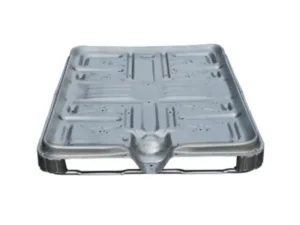
| Structural Base Pallets | Galvanized Steel, Aluminum Alloy, Plastic | 1200 x 1000 x 1160 mm Standard Footprint | Rust-proof, heavy-duty stackability up to 4-high | Automated warehousing, multi-modal container transport |
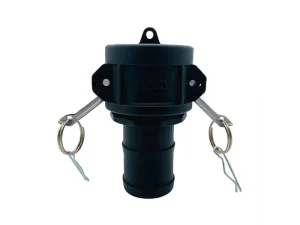
| Drain Spouts & Adapters | High-Grade Nylon, PP, Brass, Stainless | Camlock Type A/F, Elbow Spouts, Hose Barbs | High impact resistance, dynamic pressure tightness | On-site chemical dispensing, industrial processing plants |
Industrial Use Cases & Customized Field Solutions
Tailored component configurations matching specific global industry compliance mandates.
1. Specialty Chemicals & Corrosive Media
Handling aggressive compounds such as hydrochloric acid, sodium hydroxide, or fluorosilicic acid requires absolute material inertness. Standard metal fittings degrade rapidly under acid mist exposure. China factories solve this by manufacturing all-polymer integrated DN80 butterfly valves fused with solid PTFE seats and high-density PE body shells. Screw lids are equipped with double-o-ring Viton gaskets to prevent toxic fugitive emissions during long haul rail and maritime shipping.
2. Hygienic Food Grade & Pharmaceutical Liquids
Food processing facilities handling bulk syrup, edible oils, dairy concentrates, and liquid food additives demand strict FDA CFR 177.1520 and EU Regulation 10/2011 compliance. China suppliers provide 1000L Stainless Steel 304/316L IBC tanks paired with sanitary tri-clamp DN50 ball valves. Seamless weld polishing (Ra < 0.4 µm) eliminates bacteria-trapping crevices, supporting rigorous Clean-in-Place (CIP) and Sterilize-in-Place (SIP) procedures.
3. Agrochemical & Liquid Fertilizer Distribution
Seasonal farming operations demand rugged equipment that withstands direct solar UV radiation, extreme temperature swings, and rough field handling. UV-stabilized heavy-duty HDPE tank lids, paired with 90-degree nylon elbow drain spouts, allow farmers to easily connect IBC totes directly to tractor sprayers without leakages or hose kinkage, maximizing operational efficiency during peak planting cycles.
4. Eco-Reconditioning & Container Recycling Loops
Global sustainability mandates require IBC tote washing and reconditioning plants to replace damaged valves, stripped thread caps, and worn base pallets before recirculating totes back into market. High-volume China factories support reconditioners by supplying universal S60x6 replacement valves and lightweight aluminum pallet bases designed for fast turnarounds and lower freight costs.
Technology Roadmap & Future Outlook (2026–2032)
The multi-stage evolution of intelligent, zero-emission IBC fluid handling systems engineered in China.
Phase 1: Advanced Fluorination & Lightweighting (Current)
Mass implementation of online surface fluorination technology during blow-molding processes. Transitioning traditional heavy steel bottom pallets to high-tensile, rust-proof extruded aluminum alloy bases, reducing container tare weight by 14kg while maintaining 4-high dynamic stacking limits.
Phase 2: IoT Telemetry & Smart Valve Integration (2027-2029)
Embedding micro RFID tags, pressure sensors, and Bluetooth low-energy (BLE) fluid level trackers directly into the plastic mold of top caps and DN50 valves. Real-time monitoring of thermal expansion, vapor pressure, and unauthorized valve manipulation during ocean shipping.
Phase 3: Circular Economy & Bio-Based Polymers (2030+)
Developing 100% recyclable mono-material IBC valve assemblies where handle, ball, body, and stem can be shredded and re-extruded without manual component disassembly. Integrating bio-attributed HDPE resins derived from post-consumer waste streams to reduce cradle-to-gate carbon footprint.
High-Demand IBC Fittings, Adapters & Specialized Tanks
Complete your sourcing pipeline with factory-direct replacement parts, food-grade containers, and heavy-duty fluid transfer spouts.
Frequently Asked Questions: B2B Technical Procurement
Expert responses to critical engineering, manufacturing, and international trade queries regarding China IBC fittings.
What are the standard thread dimensions for IBC bottom valves, and how do S60x6 and S100x8 differ?
The most common international thread standard for 1000L IBC bottom valves is S60x6 (2-inch coarse thread), featuring an outer diameter of 60mm and a thread pitch of 6mm. This standard is universally compatible with standard Schutz, Mauser, and Greif container specifications. The S100x8 (3-inch coarse thread) valve is used primarily for high-viscosity fluids or high-flow discharge requirements, with a 100mm outer diameter and 8mm pitch. China factories supply standard adapters to step down S100x8 valves to S60x6 or standard NPT/BSP male threads for rapid hose coupling.
How do I choose between EPDM, PTFE, Viton (FKM), and NBR gaskets for chemical transportation?
Gasket selection depends strictly on the chemical nature of the liquid stored:
- PTFE (Polytetrafluoroethylene): Universal chemical resistance; ideal for strong acids, solvents, and aggressive organic chemicals. Non-reactive, wide temperature range (-40°C to +200°C).
- Viton (FKM): Excellent resistance to hydrocarbons, fuels, oils, and concentrated acids at elevated temperatures.
- EPDM: Superior resistance to steam, water, alkalis, and polar solvents like ketones and alcohols; unsuitable for petroleum fats or oils.
- NBR (Nitrile): Cost-effective choice for petroleum products, mineral oils, vegetable oils, and general water-based media.
Why choose a vented (breathable) red cap over a solid black sealing cap for IBC totes?
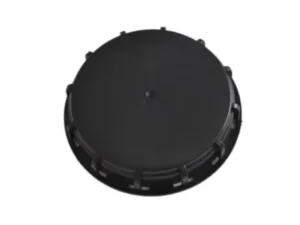
A vented/breathable lid features an integrated hydrophobic microporous ePTFE membrane. It is strictly required when transporting off-gassing chemicals (such as hydrogen peroxide, peracetic acid, or organic liquid fertilizers) or when operating high-speed discharge pumps where internal vacuum collapse could destroy the HDPE bottle. A solid black sealing cap utilizes a thick internal gasket to create an impermeable airtight barrier; it is ideal for non-gassing, stable chemical solvents, food syrups, and long-term static warehouse storage.
What quality control testing procedures are conducted by a certified China IBC fittings factory?
A premier China IBC fittings supplier executes a rigorous four-stage quality assurance protocol:
- Helium & Pneumatic Pressure Leak Testing: 100% of finished butterfly and ball valves are pressure-tested underwater at 0.3 bar to verify seal integrity.
- Drop & Hydrostatic Burst Testing: Assembled IBC totes undergo 1.9m drop tests at -18°C and internal hydrostatic pressure testing up to 100 kPa for UN dangerous goods compliance.
- Polymer Melt Flow Index (MFI) & Tensile Analysis: Raw HDPE resins are tested to prevent environmental stress cracking (ESCR).
- Dimensional Precision Verification: CMM (Coordinate Measuring Machine) inspection ensures thread tolerances remain within +/- 0.005mm.
What is the typical lead time, MOQ, and OEM customization capability for wholesale orders?
Standard catalog items (such as standard DN50 S60x6 butterfly valves, 150mm screw caps, and PTFE replacement washers) are maintained in bulk inventory with a rapid dispatch window of approximately 3 to 7 business days. For customized OEM/ODM projects requiring custom masterbatch colors, engraved corporate logos on stainless steel nameplates, or specialized mold development, tooling production takes 15 to 25 days, with mass production lead times confirmed upon sample approval. Minimum order quantities (MOQs) range from 50 units for specialized valves up to full container loads (20GP/40HQ) for high-volume component procurement.